Looking for Reliable Elderly Health Care Services? Here's What to Check
Choosing elderly health care services for a parent? What to verify — caregiver training, pricing, and emergency support — before you hire.
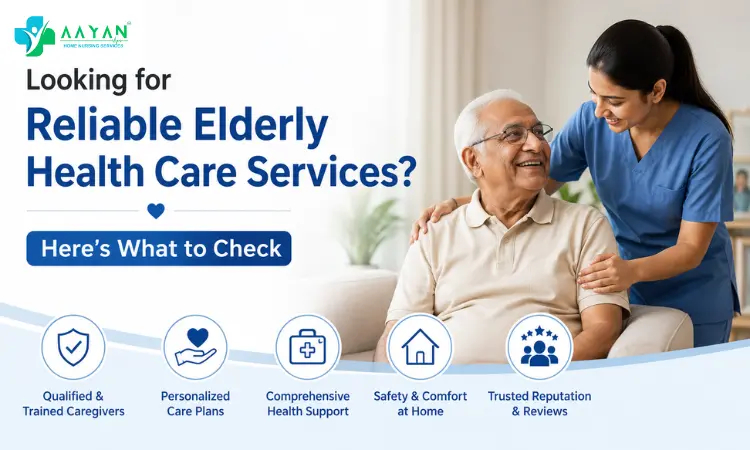
Nuclear family households in India rose from roughly 70% to over 74% of all households between the last two Census cycles, a shift that has left millions of ageing parents without a family member physically present during working hours. Elderly Health Care Services fill this gap bringing trained support into a senior's own home rather than requiring a move to an institutional facility.
This guide covers exactly what to check before hiring a provider — caregiver qualifications, service range, pricing transparency, emergency response, and communication standards — so families can make this decision with confidence rather than guesswork.
Why Choosing the Right Elderly Health Care Services Matters
Quality of care directly affects a senior's physical health, emotional wellbeing, and mental wellness — and the gap between adequate and excellent care is measurable, not just a matter of comfort.
|
What Quality Care Delivers |
What Inadequate Care Risks |
|
Consistent medication management |
Missed or duplicated doses, drug interactions going unnoticed |
|
Early detection of health changes |
Delayed response to deterioration, avoidable hospital admissions |
|
Structured daily routine and mobility support |
Faster physical decline, increased fall risk |
|
Regular family updates |
Family anxiety, delayed awareness of emerging problems |
|
Emotional engagement and companionship |
Isolation, depression, disengagement from daily life |
Check the Experience and Qualifications of Caregivers
A caregiver's training determines whether a health complication is caught early or missed entirely. Before hiring home health care for elderly patients, verify the caregiver's background against this checklist.
6 Conditions a Trained Caregiver Should Understand
• Diabetes — blood sugar monitoring, dietary timing, hypoglycaemia recognition
• Hypertension — medication timing, symptom awareness, activity guidance
• Arthritis — mobility support, joint-safe assistance techniques
• Stroke recovery — mobility rehabilitation support, speech and swallowing awareness
• Dementia — routine consistency, safe redirection techniques, wandering prevention
• Parkinson's disease — fall prevention, medication timing sensitivity, tremor-adapted assistance
• Professional certification and first-aid training: caregivers should hold documented training in elderly care protocols and basic first aid, with emergency response skills current and verifiable
• Compassionate communication: experience alone is not enough — the caregiver's manner directly affects a senior's willingness to accept help and follow care instructions
• Background and police verification: non-negotiable for any caregiver entering a senior's home — request written confirmation from the agency
• Continuous training: a caregiver whose skills are updated periodically stays current on best-practice protocols for evolving age-related conditions
Ensure the Service Offers Personalized Care Plans
Every senior has different healthcare needs — a one-size routine applied uniformly across patients is a warning sign, not a convenience. In home health care for seniors should begin with an individual health assessment, not a standard package.
• Individual health assessment before the care plan is finalised
• Daily living assistance calibrated to what the senior can and cannot do independently
• Medication reminders aligned with the physician's actual prescription schedule
• Mobility assistance matched to the senior's specific fall risk and physical capacity
• Nutrition planning and meal preparation support reflecting dietary restrictions
• Personal hygiene assistance delivered with attention to dignity and privacy
• Companionship built into the daily routine, not treated as an afterthought
• Regular care plan reviews, updated as health conditions change over time
• Family involvement in the planning process from the outset
A care plan reviewed only once, at the start of service, cannot keep pace with a senior's changing needs. Ask specifically how often the plan is reassessed.
Verify the Range of Elderly Health Care Services Offered
Home health services for seniors vary widely in scope between providers. A comprehensive provider should be able to cover the full range below — not just personal care, and not just clinical nursing, but both.
|
Category |
Services Typically Included |
|
Personal care |
Bathing assistance, grooming support, personal hygiene, mobility assistance |
|
Clinical nursing |
Medication management, nursing care at home, vital signs monitoring, doctor visit coordination |
|
Condition-specific care |
Dementia care, Alzheimer's care, Parkinson's care, stroke rehabilitation support |
|
Recovery and complex care |
Post-hospital recovery care, palliative care, bedridden patient care |
|
Companionship |
Social engagement, conversation, accompaniment for outings where appropriate |
Choosing one provider that offers multiple services delivers continuity of care as a senior's health needs evolve — a family that starts with personal care support and later needs post-surgical nursing does not have to onboard a completely new provider, retrain them on the senior's history, and rebuild trust from scratch. Long-term support under one provider also produces better coordination between caregivers and the family over time.
Check Availability and Emergency Support
Health emergencies in elderly patients do not follow business hours. A provider's actual availability structure — not just their marketing claims — determines whether help arrives when it matters.
• 24/7 caregiving availability: day care, night care, weekend, and holiday coverage should all be confirmed in writing, not assumed
• Emergency response procedure: ask what the caregiver is trained to do first — including when to call 112, India's unified emergency number — before escalating to the family or physician
• Fast caregiver replacement: if the assigned caregiver is unavailable due to illness or leave, ask how quickly a verified replacement is arranged
• On-call nursing assistance: for clinical questions arising outside scheduled visits, confirm whether a nurse is reachable by phone
Read Reviews and Client Testimonials
Online reviews reveal patterns that a sales conversation will not. Check the provider's Google Business Profile rating and read individual reviews, not just the star average — a 4.6 rating built on 200 reviews tells a very different story from the same rating built on 8.
• Look specifically for reviews mentioning caregiver reliability, punctuality, and communication — not just general satisfaction
• Ask the provider directly for family references you can call, not just published testimonials
• Word-of-mouth recommendations from someone you know carry more weight than any online review
• Check whether the provider's local reputation is consistent across multiple platforms, not concentrated on one review site
Understand Pricing and Transparency
Elderly home care services should come with a written cost breakdown before service begins — not a verbal estimate that changes once care is underway. Ask for the following in writing:
|
Plan Type |
Best Suited For |
|
Hourly care |
Short daily visits — medication reminders, brief supervision |
|
Daily care |
Full-day support for seniors needing consistent daytime supervision |
|
Weekly care |
Recurring scheduled support across specific days |
|
Monthly package |
Ongoing, longer-term care arrangements with predictable monthly cost |
• Confirm what is included in the quoted price and what counts as an additional charge
• Ask directly whether there are hidden charges for weekend, holiday, or emergency coverage
• Compare providers on care quality and caregiver qualification first — the lowest quote is rarely the best long-term value
• Request a detailed written quotation before signing any agreement
Ask About Monitoring and Family Communication
A caregiver who is excellent in the home but invisible to the family creates unnecessary anxiety. Reliable providers build communication into the service structure, not into an occasional phone call.
• Daily caregiver reports: a written or verbal update at the end of each shift covering meals, medication, mood, and any observed changes
• Regular health updates: scheduled check-ins with the family beyond the daily log, particularly for seniors managing chronic conditions
• Doctor coordination: confirmation that the caregiver communicates directly with the treating physician when relevant, not only through the family
• Digital monitoring where available: some providers now offer app-based logs for medication, vitals, and daily activity — useful for outstation family members
• Emergency notification protocol: confirm exactly who is contacted, in what order, and how quickly, if a medical emergency occurs
Questions You Should Ask Before Hiring Elderly Health Care Services
|
Question |
Why It Matters |
|
Are caregivers trained and certified? |
Verifies clinical competence, not just willingness to help |
|
Are background checks completed? |
Non-negotiable safety requirement for in-home care |
|
Is emergency support available? |
Determines response quality during a genuine crisis |
|
Can services be customised? |
Reveals whether care plans are individualised or templated |
|
Are replacement caregivers available? |
Prevents care gaps when the assigned caregiver is unavailable |
|
How often are health updates shared? |
Sets communication expectations before problems arise |
|
What services are included? |
Prevents scope disputes after the agreement is signed |
|
Are there hidden charges? |
Protects against unexpected costs mid-service |
Signs You've Found a Reliable Elderly Care Provider
• Consistently positive client reviews across multiple platforms, not just a handful of curated testimonials
• Qualified, verified staff with documented training in elderly care and age-related conditions
• Transparent pricing with a written breakdown provided before service begins
• Quick response time to initial enquiries and ongoing communication
• Individually personalised care plans, reassessed as the senior's condition changes
• Professional, compassionate behaviour observed during the initial consultation
• Flexible service plans that adjust to changing family and medical circumstances
• Strong, accessible customer support — not just a call centre that is hard to reach after signing
Making the Right Choice for Your Family
Selecting Elderly Health Care Services is a decision that affects a parent's comfort, safety, independence, and dignity every single day the arrangement is in place. Qualified caregivers, a properly personalised care plan, transparent pricing, real emergency support, and a verifiable track record of positive client experiences are the factors that separate a reliable provider from one that only sounds reliable in a sales conversation.
Compare providers on these specific points rather than on price or convenience alone — the difference shows up in the quality of daily life your parent actually experiences.
|
Disclaimer: This article is for informational purposes only and does not constitute medical or professional care advice. Consult a qualified healthcare professional or licensed home care agency before making any care decisions for your family member. |
|
Looking for Trusted Elderly Health Care Services? Aayan Global provides professional in-home elderly care tailored to every senior's medical and personal needs, across Bangalore, Mangalore, and Udupi. From daily assistance to specialised nursing care, our background-verified caregivers support your family with reliable, compassionate care at home. Mangalore: +91 73495 13467 / +91 96119 12556 Bangalore: +91 81472 97666 |
Frequently Asked Questions
1. What is the difference between elderly home care services and hiring an independent caregiver?
A registered agency provides background-verified, trained caregivers with replacement coverage if someone is unavailable, structured supervision, and accountability. An independently hired caregiver may cost less but carries more risk — verification, training consistency, and backup coverage become entirely the family's responsibility.
2. How do I know if my parent needs home health care for elderly support or full-time nursing?
Personal care support (bathing, mobility, medication reminders) is sufficient for seniors managing routine age-related decline. Full-time nursing is appropriate when a senior has an active medical condition requiring clinical monitoring — post-surgical recovery, complex medication management, or a diagnosed condition like advanced diabetes or a recent stroke. An initial health assessment from the provider should clarify which level applies.
3. Can in home health care for seniors be arranged on a short-term basis?
Yes. Many families start with short-term arrangements — post-hospital recovery, a family member's travel period, or a trial before committing to long-term care. Reliable providers offer hourly, daily, and weekly plans specifically for these situations, without requiring a long-term contract upfront.
4. What should I do if I am not satisfied with the assigned caregiver?
A reliable provider should have a documented process for caregiver replacement without penalty. Raise the concern directly and specifically — punctuality, communication, or a skills gap — rather than waiting to see if it improves on its own. If the agency cannot provide a replacement within a reasonable timeframe, that is itself a signal about their service quality.
5. Is 24/7 elderly care more expensive than scheduled daily visits?
Yes, 24-hour or live-in care costs more than scheduled hourly or daily visits, but it is priced as a monthly package rather than accumulated hourly charges, which often makes it more cost-effective for seniors who actually need continuous supervision. For seniors who need only specific daily support — medication reminders, meal assistance — scheduled visits are usually the more appropriate and economical choice.
|
Disclaimer (FAQ): The answers above are for informational purposes only. Individual care needs vary significantly by health condition and must be assessed by a qualified healthcare professional. Consult a licensed home care agency or your family physician before making care arrangement decisions. |
|
Written by L K Monu Borkala Chief Strategist, OneCity Technologies L K Monu Borkala is a digital marketing strategist with 20+ years of experience producing informational content across healthcare services, home care, and professional services verticals. This article is produced for informational purposes only. Consult a licensed healthcare provider or registered home care agency before making decisions about home nursing or care arrangements. LinkedIn: https://www.linkedin.com/in/monuborkala/ |
What's Your Reaction?