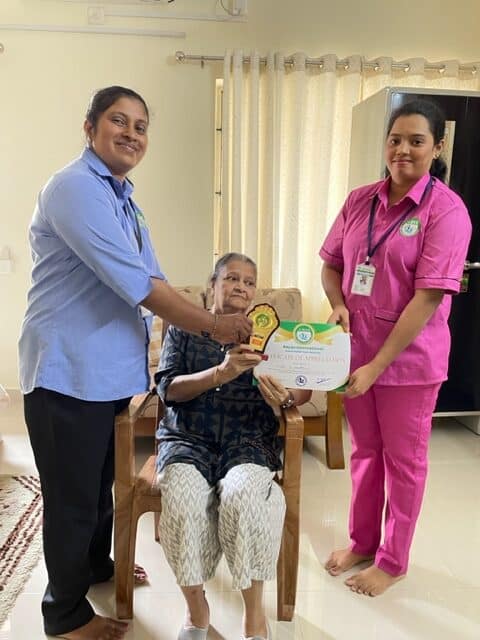
Dementia care at home in Bangalore provides trained supervision, daily routine structuring, medication management, and behavioural support for patients with Alzheimer's disease, vascular dementia, Lewy body dementia, and other forms of cognitive decline. The home environment is typically better for dementia patients than institutional care because familiar surroundings – their own bedroom, their own kitchen, photographs on the wall – reduce confusion and agitation. Unfamiliar settings make disorientation worse.
A trained caregiver handles early-stage dementia: medication reminders, safety checks, social engagement, and daily routine management. Rates start at 15,000/month for a 12-hour day shift and 25,000/month for 24-hour coverage. A GNM nurse is needed for mid-stage dementia with medication management, hygiene assistance, and behavioural monitoring (20,000 – 28,000/month for 12 hours). A BSc nurse is required for late-stage dementia with feeding tubes, catheters, or pressure sore care (35,000 – 45,000/month for 12 hours). This page covers dementia stages and corresponding care needs, sundowning management, wandering prevention, caregiver rotation, pricing, and coordination with Bangalore neurologists and psychiatrists.
Dementia care options in Bangalore are largely facility-based – Cadabams (Yelahanka), KITES Senior Care, and Nightingales Trust operate memory care units with shared rooms. Aayan provides the home-care alternative: 1:1 caregiver attention in the patient's own home, where the familiar environment itself serves as a therapeutic tool. For families who want their parent or spouse to remain at home, trained home care delivers the same supervision and safety protocols that facilities provide, without the disorientation of relocation.
Dementia Stages and Care Needs
Dementia is progressive – care requirements increase as the condition advances through three broad stages. Matching the right caregiver or nurse to the current stage prevents both under-care (safety risks) and over-care (unnecessary expense).
Early stage (mild): The patient experiences memory lapses – forgetting recent conversations, misplacing keys or wallets, repeating questions, word-finding difficulty during conversation. Some personality changes appear: withdrawal from social activities, irritability, mild anxiety. The patient can still perform most daily activities independently but needs monitoring. Care focus at this stage includes daily routine structuring (consistent wake time, meal times, activity times), medication reminders, safety checks around the home (gas stove, door locks, electrical appliances), and maintaining social engagement to slow cognitive decline. A trained caregiver is usually sufficient at this stage – clinical nursing skills are not yet needed.
Middle stage (moderate): This is typically the longest stage, lasting several years. Significant memory loss affects daily function – the patient forgets names of family members, confuses past and present, cannot recall their address or phone number. Confusion about time and place increases: the patient may not recognise their own home or may try to "go home" while already there. Wandering becomes a risk – the patient may leave the house without purpose and become lost. Sundowning (evening agitation and confusion) is common in this stage. Difficulty with daily activities increases: the patient needs help with bathing, dressing, toileting, and grooming. Behavioural changes emerge – aggression, suspicion of family members, hiding objects, repetitive questioning, and occasionally inappropriate behaviour. Care focus shifts to 24-hour supervision, structured activities to reduce restlessness, fall prevention, hygiene assistance, and managing behavioural symptoms through redirection and calming techniques. A GNM nurse is recommended at this stage for medication management, behavioural monitoring, and clinical documentation.
Late stage (severe): The patient loses the ability to communicate coherently – speech reduces to a few words or becomes unintelligible. Recognition of family members fades. Complete dependence for all activities of daily living: feeding, toileting, bathing, dressing, and mobility. Swallowing difficulty (dysphagia) increases aspiration risk, and many patients require modified-texture diets or feeding tubes. Incontinence – both urinary and faecal – is constant. Immobility leads to pressure sore risk, muscle contractures, and deep vein thrombosis. Care focus becomes total care: assisted or tube feeding with aspiration precautions, repositioning every 2 hours, meticulous skin and hygiene care, comfort measures, and monitoring for infections (urinary, respiratory, skin). A BSc nurse is required at this stage for feeding tube management, catheter care, pressure sore treatment, and clinical assessment of complications.
Enquire About Dementia Care
Contact Us
Sundowning Management
Sundowning refers to a pattern of increased confusion, agitation, anxiety, and restlessness that begins in the late afternoon and worsens into the evening. It affects an estimated 20 to 45 percent of dementia patients, particularly those in the middle stage. The exact cause is not fully understood, but contributing factors include disruption of the circadian rhythm, fatigue accumulated through the day, reduced lighting that increases shadows and visual misperception, and difficulty separating dreams from reality as drowsiness sets in.
Management strategies our caregivers follow:
Maintain a consistent daily routine – same wake time, meals, activities, and bedtime every day. Predictability reduces anxiety. Increase lighting in the afternoon – open curtains, switch on bright lights before dusk. Dim, shadowy rooms worsen confusion and can trigger visual hallucinations. Reduce stimulation after 4 PM – turn off loud television, avoid visitors during this window, lower background noise. Plan calm evening activities: folding towels, sorting objects, listening to familiar music from the patient's younger years, or looking through family photo albums. Offer a light evening snack – hunger can worsen agitation. Avoid caffeine after noon, including tea. Ensure the room temperature is comfortable – being too warm or too cold increases restlessness.
Caregiver's role during sundowning episodes: The caregiver redirects agitated behaviour without confrontation – never arguing, correcting, or saying "you're wrong." Speaking in a calm, low voice with short sentences. Offering a glass of water or a familiar object. Gentle touch on the hand or shoulder if the patient accepts it. If the patient wants to walk, the caregiver walks alongside them in a safe indoor area rather than trying to force them to sit. Prescribed PRN (as-needed) medications are administered only when non-pharmacological approaches are not effective and the treating psychiatrist has authorised their use.
When to involve the specialist: If sundowning episodes increase in frequency or intensity, if the patient becomes physically aggressive during episodes, if hallucinations or delusions accompany the agitation, or if the patient's sleep-wake cycle reverses entirely (awake all night, asleep all day), the caregiver documents the pattern and the treating neurologist or psychiatrist reviews for medication adjustment. NIMHANS geriatric psychiatry and Manipal Hospital's neurology department both manage complex sundowning cases.
Wandering Prevention
Wandering is one of the most dangerous behaviours in mid-stage dementia. The patient may walk out of the house, become disoriented within minutes, and be unable to find their way back or communicate their address. In Bangalore's dense traffic and sprawling layout, an unsupervised wandering episode can result in injury, heat exhaustion, or the patient being found kilometres from home.
Why dementia patients wander: Disorientation – the patient does not recognise their surroundings and searches for a "familiar" place, often a childhood home. Restlessness – unstructured time and boredom trigger pacing. Unmet needs – the patient may be hungry, need the toilet, or be in pain but cannot express it. Past routines – a retired office worker may try to "go to work" at their usual time. Medication side effects – some medications cause akathisia (inner restlessness) that drives movement.
Home safety measures: Install door alarms on all exit doors – a simple chime alerts the caregiver when a door opens. Place locks above or below eye level (dementia patients typically look at eye-level locks they are accustomed to). Ensure the patient wears an ID bracelet with their name, diagnosis, and a family member's phone number at all times. Attach a GPS tracker – wearable GPS devices or smartphone-based trackers provide real-time location if the patient does leave the home. Secure balconies with additional latches and stairways with gates. Remove car keys and disable vehicles if the patient previously drove. Cover door handles with cloth covers that make them harder to grip and turn.
Caregiver's role: The caregiver maintains visual supervision at all times – the patient is never left alone in a room with an accessible exit. When the patient shows signs of restlessness (pacing, pulling at the door, putting on shoes), the caregiver redirects to a structured activity: a short walk within the home, sorting laundry, watering plants, or looking at photographs. Supervised outdoor walks at the same time each day – typically morning and late afternoon – reduce indoor restlessness significantly. The walk follows the same route each time, which provides familiarity and a sense of purpose.
Caregiver Rotation for Burnout Prevention
Dementia care is among the most demanding forms of home care. Unlike post-surgical nursing where the patient's condition improves over weeks, dementia is progressive – the patient's function declines over months and years. Repetitive questioning (the same question asked 30 times in an hour), resistance to bathing, accusations of theft, nighttime wandering, and sundowning episodes create sustained psychological stress that exhausts even experienced caregivers.
Why a single-caregiver model fails: A single caregiver providing 24-hour dementia care burns out within 4 to 8 weeks on average. The signs are predictable – short temper with the patient, skipping repositioning or exercise routines, excessive phone use during duty hours, and eventually absenteeism. Burnout-driven turnover means families cycle through caregivers every 2 to 3 months, and each new caregiver must learn the patient's specific triggers, preferences, and routines from scratch. The patient, who depends on familiarity, becomes more agitated with each change.
Aayan's rotation model: We assign 2 caregivers who rotate shifts – typically 12 hours each. Weekly rotation between day and night shifts prevents the night-shift caregiver from becoming isolated and fatigued. A backup caregiver is assigned for leave days and emergencies, someone who has met the patient and knows the care routine. Both primary caregivers maintain a shared daily log so handover is consistent. This model costs more than a single caregiver (approximately 40 – 50% more), but it prevents the burnout-turnover cycle that ultimately costs families more in retraining and disrupted care.
Family caregiver support: Many families in Bangalore provide primary dementia care themselves – a daughter, son, or spouse managing the patient's daily needs. These family caregivers often reach exhaustion without recognising it. We offer respite shifts: a trained caregiver takes over for a few hours (or an entire day) so the family member can rest, attend to their own health, or simply step away. We also train family members on communication techniques (using short sentences, not correcting false memories, validating emotions rather than facts) and safety protocols. For families providing overnight care, even a 12-hour day-shift caregiver allows the family member to sleep properly and maintain their own employment.
When to Transition to Facility Care
Home care is appropriate for the majority of dementia patients through all stages of the disease. However, there are situations where facility-based care becomes the safer option:
Late-stage dementia with multiple medical complications: When the patient develops recurrent pneumonia (from aspiration), sepsis risk from infected pressure sores, or requires frequent emergency interventions that a home nurse cannot manage alone, a facility with on-site medical staff provides faster response.
Severe behavioural symptoms not manageable at home: Physical aggression that puts the caregiver or family members at risk of injury, persistent elopement despite door alarms, locks, and GPS tracking, or psychotic symptoms (severe hallucinations, paranoid delusions) that do not respond to medication adjustments – these situations may exceed what home care can safely contain.
Family caregiver burnout beyond what rotation can address: If the primary family members are elderly themselves, have their own health conditions, or if the emotional toll of watching a parent or spouse decline has become clinically significant (depression, anxiety, insomnia), and respite shifts are not sufficient relief, facility placement allows the family to return to a visiting role rather than a caregiving role.
The transition to facility care is not a failure – it means the patient's needs have exceeded what the home setting can safely provide. It is a clinical decision, not a moral one.
Named facilities in Bangalore: Cadabams (Yelahanka) operates a dedicated memory care unit with psychiatrist access. Nightingales Trust (Hosur Road) provides long-term elderly and dementia care. KITES Senior Care offers dementia-specific shared living arrangements. Families can visit these facilities and consult with the treating neurologist before making the transition. We assist with the handover – sharing the patient's complete care history, medication records, behavioural triggers, and preferences with the receiving facility.
Dementia Care Pricing in Bangalore
Dementia care costs depend on the caregiver or nurse qualification and the shift format. Here are the current rates:
| Care Level |
12hr Shift |
24hr Coverage |
When Needed |
| Trained Caregiver |
15,000 – 20,000/month |
25,000 – 35,000/month |
Early-stage dementia, supervision, routine management, medication reminders |
| GNM Nurse |
20,000 – 28,000/month |
30,000 – 40,000/month |
Mid-stage dementia, medication management, hygiene, behavioural monitoring |
| BSc Nurse |
35,000 – 45,000/month |
55,000 – 70,000/month |
Late-stage dementia, feeding tube, catheter, pressure sore care, medical complications |
Most families start with a trained caregiver and escalate to GNM or BSc nursing as the condition progresses. Caregiver rotation (2 caregivers) adds approximately 40 – 50% to the monthly cost but prevents burnout-related turnover that disrupts care continuity. 24-hour coverage uses two caregivers or nurses rotating 12-hour shifts.
Comparison with facility-based care: Facility-based dementia care in Bangalore (Cadabams, KITES) costs 40,000 – 80,000/month for shared rooms and 80,000 – 1,50,000/month for private rooms. Home care provides 1:1 attention in familiar surroundings at comparable or lower cost. The home setting also avoids the disorientation and increased agitation that facility relocation commonly triggers in dementia patients.
For a detailed comparison of caregiver and nurse qualifications, see: Caretaker vs Nurse – Qualification, Cost & When You Need Which. For a general comparison of home nursing versus hospital costs, see: Home Nursing vs Hospital Care – Cost, Safety & Recovery Compared.
Coordinating with Bangalore Specialists
Dementia care requires ongoing specialist involvement – the caregiver or nurse at home works as an extension of the treating doctor's team, not independently. Here are the primary referral centres in Bangalore:
NIMHANS: The National Institute of Mental Health and Neuro-Sciences is the primary referral centre for dementia diagnosis in Bangalore. Their geriatric psychiatry department conducts cognitive assessments (MMSE, MoCA), neuroimaging, and differential diagnosis between Alzheimer's, vascular dementia, and other types. NIMHANS psychiatrists manage medications for behavioural symptoms – antipsychotics, mood stabilisers, and cholinesterase inhibitors. Our caregivers document daily behaviour, medication response, and sleep patterns in the format NIMHANS clinicians use for follow-up reviews.
Manipal Hospital: The neurology department at Manipal Hospital Yeshwanthpur operates a memory clinic that evaluates cognitive decline, prescribes dementia-specific medications (donepezil, memantine), and monitors progression through periodic neuropsychological testing. Our nurses carry updated care logs to every Manipal Hospital follow-up appointment.
Apollo Hospital: Apollo Hospital's geriatric medicine department manages dementia patients with multiple comorbidities – diabetes, hypertension, cardiac conditions alongside cognitive decline. Their geriatricians take a whole-patient approach, adjusting medications across all conditions rather than treating each in isolation. This is particularly important because many dementia medications interact with cardiac and blood pressure drugs.
Narayana Health: Narayana Health's neurology department handles dementia follow-ups and medication reviews. Their neurologists are accessible for phone consultations when the caregiver reports sudden changes in behaviour or cognition that may indicate a new stroke event or infection.
How coordination works day-to-day: The caregiver or nurse maintains a daily log covering behaviour patterns (agitation episodes, sundowning severity, sleep quality, appetite), medication administration and any side effects observed, wandering attempts, falls or near-falls, and communication ability. This log is shared with the treating neurologist or psychiatrist weekly via WhatsApp or email, and in full at follow-up visits. For acute changes – sudden increase in confusion, new hallucinations, refusal to eat or drink, fever, seizure – the caregiver contacts the treating doctor immediately. If the doctor is unreachable and the situation is urgent, the caregiver calls 108 (ambulance) and accompanies the patient to the nearest hospital.
Frequently Asked Questions
What is the difference between dementia and Alzheimer's?
Dementia is a group of symptoms – memory loss, confusion, impaired judgment, difficulty with language – caused by damage to brain cells. Alzheimer's disease is the most common cause, accounting for 60 to 80 percent of cases. Other causes include vascular dementia (after strokes or small vessel disease), Lewy body dementia, and frontotemporal dementia. The care approach at home is similar regardless of the underlying cause: structured routines, safety measures, medication management, and trained supervision. The treating neurologist determines the specific type through cognitive testing and brain imaging.
Can dementia patients stay at home safely?
Yes. Early and mid-stage dementia patients typically do well at home because familiar surroundings reduce confusion. Safety measures – door alarms, secured locks, GPS tracking, trained caregiver supervision – address the primary risks of wandering and accidents. Late-stage patients can also remain at home with BSc nursing support for feeding, hygiene, and medical needs. The home environment becomes unsafe only when severe aggression or persistent elopement cannot be managed despite all safety measures, or when medical complications require on-site medical staff.
How do you handle aggressive behaviour in dementia patients?
Aggression is usually triggered by pain, fear, frustration, or overstimulation – not deliberate intent. Our caregivers identify the trigger first: check for urinary infection, constipation, dental problems, or ill-fitting clothing. They approach calmly, speak in short simple sentences, avoid arguing or correcting, and redirect attention to a different activity. Physical restraint is never used. Persistent aggression is documented with times, triggers, and duration, and reported to the treating psychiatrist for medication review.
What qualifications does a dementia caregiver need?
For early-stage dementia: a trained caregiver with elderly care experience and specific training in dementia safety protocols, routine management, and communication techniques. For mid-stage dementia: a GNM nurse who can manage medications, monitor for infections, assist with hygiene, and document behavioural changes clinically. For late-stage dementia: a BSc nurse for feeding tube management, catheter care, pressure sore treatment, and management of medical complications. All our dementia caregivers receive training in sundowning management, wandering prevention, and behavioural redirection before assignment.
How much does dementia care at home cost in Bangalore?
Trained caregiver: 15,000 – 20,000/month (12hr) or 25,000 – 35,000/month (24hr). GNM nurse: 20,000 – 28,000/month (12hr) or 30,000 – 40,000/month (24hr). BSc nurse: 35,000 – 45,000/month (12hr) or 55,000 – 70,000/month (24hr). Caregiver rotation (2 caregivers for burnout prevention) adds 40 – 50% to the monthly cost. Facility-based care (Cadabams, KITES) costs 40,000 – 1,50,000/month depending on room type.
How do you manage sundowning?
Sundowning – late afternoon and evening agitation – is managed through consistent routines, bright afternoon lighting, reduced stimulation after 4 PM, calm evening activities (folding towels, familiar music, photo albums), a light evening snack, no caffeine after noon, and comfortable room temperature. The caregiver redirects agitation without confrontation – never arguing with or correcting the patient. PRN medications prescribed by the psychiatrist are used only when non-pharmacological methods are not working. Persistent sundowning is documented and reported for medication review.
Should I hire a caregiver or a nurse for dementia care?
A trained caregiver is sufficient for early-stage dementia – supervision, routine management, medication reminders, safety checks. A GNM nurse is recommended for mid-stage dementia – medication management, hygiene assistance, behavioural monitoring, clinical documentation. A BSc nurse is required for late-stage dementia – feeding tube, catheter, pressure sores, medical complications. Most families start with a caregiver and transition to nursing support as needs increase. For a detailed comparison, see: Caretaker vs Nurse Difference.
How do I book dementia care in Bangalore?
Call +91 81472 97666. Describe the patient's current stage of dementia, behavioural symptoms, medication list, and daily care needs. We assess whether a trained caregiver, GNM nurse, or BSc nurse is appropriate and match someone with dementia care experience to the patient. The caregiver or nurse can start within 24 – 48 hours. We coordinate with the treating neurologist or psychiatrist for ongoing medication reviews and follow-up visits.