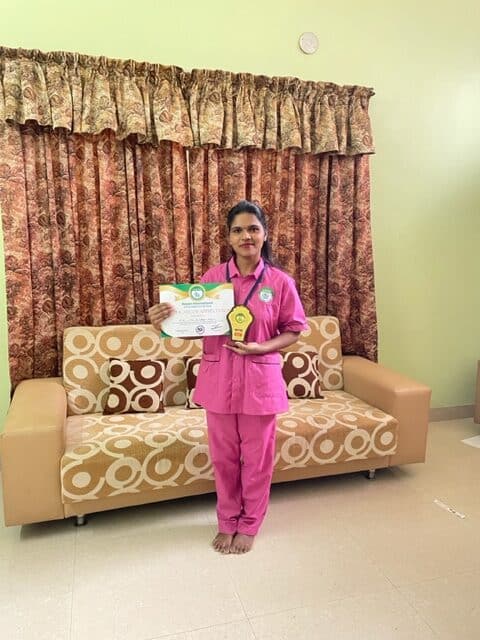
A caretaker helps with daily activities such as bathing, feeding, and mobility. A nurse holds a formal qualification – ANM, GNM, or BSc Nursing – and can perform clinical procedures like injections, catheter management, and wound care. The right choice depends on the patient's condition, not price alone. This guide breaks down qualifications, what each role is allowed to do, cost ranges, and a decision framework so you hire the right person.
The Four Qualification Tiers Explained
Home care staffing in India falls into four tiers based on training and scope of practice. Each tier is regulated differently, and the tasks they can legally perform are distinct.
1. Caretaker (No Formal Nursing Qualification)
Training: Short-term vocational courses (2 weeks to 3 months) or on-the-job training. No certification from the Indian Nursing Council.
What they do: Assist with bathing, grooming, feeding, toilet support, mobility within the home, light housekeeping related to the patient, companionship, and medication reminders (oral medicines only).
What they cannot do: Injections, IV drips, catheter insertion or removal, surgical wound dressing, oxygen therapy monitoring, ventilator care, tracheostomy care, or any invasive procedure.
Suitable for: Elderly patients who are relatively stable, need daily living support, and have no clinical nursing requirements.
2. ANM – Auxiliary Nurse Midwife
Training: Two-year diploma programme recognised by the Indian Nursing Council. Covers basic nursing, first aid, community health, and maternal care.
What they do: Everything a caretaker does, plus vital sign monitoring (blood pressure, temperature, pulse, oxygen saturation), basic wound care, oral and topical medication administration, blood sugar testing, and patient condition reporting to the supervising doctor.
What they cannot do: IV cannulation, catheter insertion, complex wound dressing (surgical drains, vacuum-assisted closure), ventilator management.
Suitable for: Elderly patients with controlled chronic conditions (diabetes, hypertension), post-discharge monitoring where no invasive procedures are needed.
3. GNM – General Nursing and Midwifery
Training: Three-and-a-half-year diploma with mandatory hospital clinical rotations across medical, surgical, paediatric, and obstetric wards.
What they do: All ANM tasks, plus IV cannulation, catheter insertion and management, surgical wound dressing, drain management, injection administration (IM, SC, IV), nasogastric tube feeding, oxygen therapy setup and monitoring, tracheostomy suctioning, and stoma care.
What they cannot do: Independent ventilator management, ICU-level critical care monitoring (though they may assist under supervision).
Suitable for: Post-surgery patients, patients with catheters, patients requiring regular injections (insulin, anticoagulants), wound care after hospital discharge.
4. BSc Nursing
Training: Four-year degree programme with extensive clinical rotations, including ICU and critical care units. Many BSc nurses hold additional certifications in BLS (Basic Life Support) or ACLS (Advanced Cardiac Life Support).
What they do: All GNM tasks, plus ventilator monitoring and settings adjustment (under doctor's telephonic guidance), central line dressing, advanced haemodynamic monitoring, post-ICU patient management, complex medication titration, and coordination with the treating physician for clinical decision-making.
Suitable for: Post-ICU patients, ventilator-dependent patients, tracheostomy patients requiring round-the-clock clinical monitoring, complex multi-system cases.
Need Help Choosing the Right Care?
Book Free Assessment
Qualification Comparison Table
| Criteria |
Caretaker |
ANM |
GNM |
BSc Nursing |
| Training Duration |
2 weeks – 3 months |
2 years |
3.5 years |
4 years |
| Qualification Body |
None (vocational) |
Indian Nursing Council |
Indian Nursing Council |
Indian Nursing Council |
| State Registration |
Not required |
Karnataka State Nursing Council |
Karnataka State Nursing Council |
Karnataka State Nursing Council |
| Injections |
No |
No |
Yes (IM, SC, IV) |
Yes (all routes) |
| Catheter Management |
No |
No |
Yes |
Yes |
| Wound Dressing (Surgical) |
No |
Basic only |
Yes |
Yes (including complex) |
| IV Drip / Cannulation |
No |
No |
Yes |
Yes |
| Ventilator Care |
No |
No |
Assist only |
Yes |
| Oxygen Therapy |
No |
No |
Yes |
Yes |
| 24hr Shift Cost (approx/month) |
12,000 – 18,000 |
18,000 – 22,000 |
25,000 – 35,000 |
35,000 – 50,000 |
Costs are indicative ranges across Karnataka. Actual pricing depends on city, patient condition, and shift format. Call for an exact quote.
Decision Guide: Which Qualification Does Your Patient Need?
The qualification tier is not about preference – it is determined by what the patient's condition requires. Here are real scenarios to help you decide:
Scenario 1: Your elderly father needs help with daily routines
He is 78, mobile with a walker, has controlled blood pressure, takes oral medication, and needs someone to help with bathing, meals, and companionship during the day.
You need: A trained caretaker. No clinical procedures are involved. An ANM is an option if you want vital sign monitoring as an added layer of safety.
Scenario 2: Your mother was discharged after knee replacement surgery
She has a surgical wound that needs dressing every two days, is on injectable blood thinners for 10 days, and has a urinary catheter that will be removed after a week.
You need: A GNM nurse at minimum. Catheter management, injection administration, and surgical wound dressing all fall outside a caretaker's or ANM's scope.
Scenario 3: Your grandfather had a stroke and is bedridden
He has a nasogastric (Ryles) tube for feeding, needs repositioning every 2 hours to prevent pressure sores, and requires suctioning for secretion management.
You need: A GNM nurse for standard stroke recovery care. If he is on a ventilator or has a tracheostomy, a BSc nurse with ICU experience is necessary.
Scenario 4: Your family member is on a home ventilator after ICU discharge
The patient has a tracheostomy, requires ventilator monitoring, has an IV line for medication, and needs round-the-clock vital sign tracking.
You need: A BSc nurse with ICU experience. Ventilator care, tracheostomy management, and critical monitoring are beyond GNM scope for independent practice.
Legal Scope of Practice in India
The Indian Nursing Council defines the scope of practice for each qualification tier. This matters because hiring an unqualified person for clinical tasks creates risk for the patient and legal liability for the family.
Caretakers are not regulated by the Indian Nursing Council. There is no standardised training requirement or registration process. Quality varies significantly between agencies.
ANM, GNM, and BSc nurses must register with their State Nursing Council (in Karnataka, the Karnataka State Nursing Council). Registration is renewable and can be verified. A nurse practising without valid registration is practising illegally.
At Aayan, every nurse's Karnataka State Nursing Council registration is verified independently before assignment. We do not deploy nurses whose registration has lapsed or is under review.
Cost Factors Beyond Qualification
The qualification tier is the primary cost driver, but several other factors affect the final rate:
Shift format: A 12-hour shift costs less than a 24-hour shift. Live-in arrangements (where the nurse stays in the home) are priced differently from rotational 24-hour care (two nurses alternating).
Patient condition severity: A bedridden patient with multiple tubes and drains requires more intensive nursing than a mobile elderly patient. Higher-acuity cases attract higher rates even within the same qualification tier.
Location: Rates in Bangalore are typically 15 – 20% higher than in Mangalore or Udupi due to higher cost of living and nurse availability. Rural areas may have a travel surcharge if the nurse commutes from the nearest city.
Duration of engagement: Monthly rates are lower per day than short-term bookings (1 – 2 weeks). Long-term engagements of 3 months or more may qualify for adjusted rates.
For specific pricing in your city, see our cost guides:
How Aayan Matches the Right Person to Your Case
We do not assign nurses based on phone conversations alone. The process works like this:
Step 1 – Initial call: You describe the patient's condition, hospital discharge summary (if applicable), and care needs. This gives us a preliminary idea of the qualification tier needed.
Step 2 – Home assessment: A coordinator visits the patient at home. They evaluate the actual clinical needs, check the home setup (bed type, bathroom accessibility, space for equipment), and review the medication schedule.
Step 3 – Qualification matching: Based on the assessment, we recommend the appropriate tier. If your father needs only daily living support, we will tell you a caretaker is sufficient – we will not push a GNM nurse when it is not clinically needed.
Step 4 – Nurse assignment: We match a specific nurse whose experience aligns with the case. A nurse who has handled post-knee-replacement cases is assigned to post-knee-replacement patients, not to elderly companionship cases.
If the patient's condition changes – for example, a stable elderly patient develops a pressure ulcer that needs clinical wound care – we reassess and upgrade the assigned staff to the appropriate qualification.
Common Mistakes Families Make When Hiring
Hiring a caretaker for clinical needs to save money. If your patient needs catheter changes, injections, or wound dressing, a caretaker cannot do this safely. The short-term savings are not worth the risk of infection, improper technique, or a medical emergency.
Hiring a BSc nurse for basic elderly care. A BSc nurse for a mobile, stable elderly patient is an unnecessary expense. Their skills are designed for ICU-level and critical care. Match the qualification to the actual clinical requirement.
Not verifying the nurse's registration. Some agencies deploy staff whose nursing council registration has lapsed or who hold certificates from unrecognised institutions. Always ask for the registration number and verify it with the State Nursing Council.
Assuming all agencies use the same qualification standards. The terms "nurse" and "caretaker" are used loosely across the industry. Some agencies call their caretakers "trained nurses" without any formal qualification. Ask specifically: what qualification does this person hold, and is their registration current?
Frequently Asked Questions
What is the difference between a caretaker and a nurse?
A caretaker assists with daily living activities such as bathing, feeding, and mobility support. They have no formal nursing qualification and cannot perform clinical procedures. A nurse (ANM, GNM, or BSc) holds a recognised qualification from the Indian Nursing Council and can administer injections, manage catheters, dress surgical wounds, and monitor vitals.
Can a caretaker give injections or manage an IV drip?
No. Injections, IV drips, catheter insertion, and wound dressing for surgical sites require at minimum a GNM-qualified nurse. A caretaker is not trained or legally permitted to perform these procedures.
Which qualification do I need for post-surgery care at home?
For post-surgery care involving wound dressing, drain management, or IV medication, a GNM nurse is the minimum requirement. If the patient was in the ICU, a BSc nurse with ICU experience is recommended.
How much does a caretaker cost compared to a nurse?
A caretaker for a 24-hour shift typically costs between 12,000 and 18,000 per month. An ANM nurse ranges from 18,000 to 22,000, a GNM nurse from 25,000 to 35,000, and a BSc nurse from 35,000 to 50,000 per month for a 24-hour shift. Rates vary by city and patient condition.
Is a caretaker enough for elderly care at home?
For elderly patients who are mobile and need help with daily routines, meals, and companionship, a trained caretaker is usually sufficient. If the patient has diabetes requiring insulin injections, a urinary catheter, bed sores, or post-surgical needs, a qualified nurse is required.
What does ANM, GNM, and BSc Nursing mean?
ANM (Auxiliary Nurse Midwife) is a two-year diploma covering basic nursing and community health. GNM (General Nursing and Midwifery) is a three-and-a-half-year diploma with hospital clinical rotations. BSc Nursing is a four-year degree covering advanced clinical procedures, ICU protocols, and critical care.
Can I switch from a caretaker to a nurse later?
Yes. If a patient's condition changes and requires clinical procedures, you can upgrade from a caretaker to a qualified nurse. At Aayan, we reassess the care plan during periodic reviews and recommend the appropriate qualification tier.
How do I verify a nurse's qualification?
Every nurse should have a valid registration with their State Nursing Council. At Aayan, we independently verify Karnataka State Nursing Council registration for every nurse before assignment. You can also check registration status on the Indian Nursing Council website.